
Ojo Caliente, just a few minutes north of Santa Fe, had not yet developed into the luxurious spa resort it is today when I got lost there. I’d heard a frail young woman on the train tell how its waters helped her illness. She planned to return there after the next surgery on yet another part of her brain. I unfolded my New Mexico map and searched the northeastern quadrant for tiny font spelled in Spanish.
–
The last stretch of road was as dry and dusty as I expected. It was early March and the midday sun felt good as I walked the premises looking for humans or a welcome center. No wind. Sparse clouds. Blue sky. One old building looked like a boarding house from any old western movie so I knocked, with knuckles and voice, and entered.
Choices explained to me all seemed reasonable: $20 for a full day to try each of the five different mineral pools or $60 to include the night in the old hotel and breakfast in the morning. After dropping my backpack on the bed, I decided to explore the nearby area and try the pools after supper.
The bluff behind the main building was easy to scale. I was raised in northeastern Colorado with similar caliche bluffs as my playground. I wandered those home pastures for days as a child, never once disoriented. However, soon, too soon, I was lost.
How could this happen? The sun was overhead, so cast no shadows to indicate direction. I couldn’t see any buildings or trees that might indicate a settlement – even the settlement I just hiked up from. I had lost all signs of the trail. I still believed there was a trail; I had just followed one up here through a rocky washout to this plateau. I followed something like a dusty cow path toward the south along the middle of that ridge. But somewhere along the hike, the gravel and knee-high sage brush all began to look all alike.
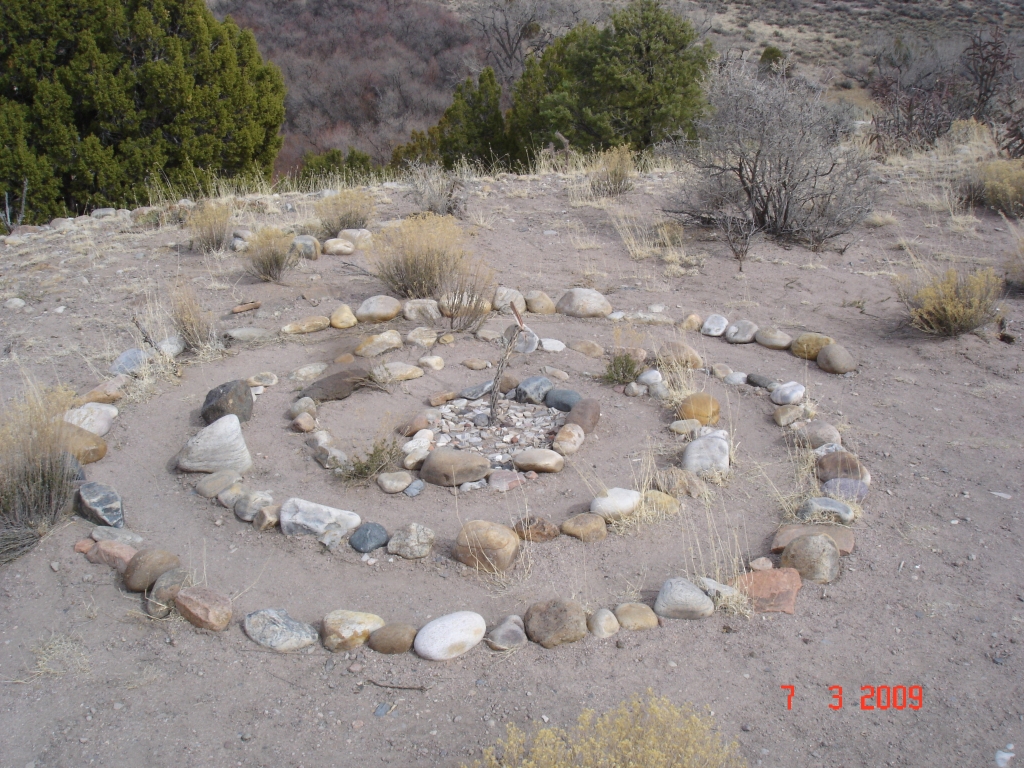
I looked up and tried to deduce a goal, target. A building? A tree? Nothing evident. Broken pottery shards indicated previous peoples had spent time here, some even arranged in circles, but I couldn’t figure out a pattern that would offer any direction or mapping code. Their pretty pattern was useless to me.
When I looked down, searching for some indication of a trail, I became unclear whether I was coming or going. Whether I was nearer the beginning or end of this route. Without markers or trail, my walking was wandering. Energy wasted, not well-spent.
I picked out a particular sage plant and designated it my anchor. I stepped off a circle of ten feet diameter counterclockwise toward the west to see if I could find a walking path. Nope. Stepped off another circle toward the south. Nope. I felt tension in the muscles along my spine, like a deer, alert.
The circle to the east just brought me closer to the edge of the plateau, and still no trail. I wasn’t concerned about food or water yet, just impatient with myself.
I should know how to do this. How can I be lost when I can see horizon to horizon? I don’t get lost in the wild. Never had been lost before.
I made a decision to head toward the only land feature I was sure of. The river below, flowing along the base of this plateau. I felt confident I could navigate the 300-foot steep slope, the brush, rock, and wildlife just like I had as a kid. We had cactus and rattle snakes there too.
Not giving up the idea that the trail was probably close to me but just beyond what I could see. Even though I’d failed to pause occasionally to orient myself to my surroundings, it still puzzled me how I could have gotten so off track.
Was I lost? Or was I just a little off the path? How far away from a path qualifies as “lost”? I could have been a few feet off the path and not know it. I could see the sky horizon to horizon. If that the same as being lost? I was definitely without direction at that point.
With my mind disoriented and tension building, all directions seemed pointless.
Yes, I walked around that plateau for a long time, looking for a trail, but staying oriented to a specific group of brush a bit taller than the surroundings. Working to increase trust that the sun would eventually cast shadows I could anchor to.
I came upon a Native American posi, a circular spiral of rocks, and walked it like a labyrinth, praying. Standing in its center, the nearby sage finally cast a shadow. A few yards beyond, standing near the ledge of my plateau, I finally got my bearings. The Ojo camp about a mile north smiled its adobe pink smile and I smiled back.
These days, I recognize my disorientation sooner, and can better differentiate it from fear. I approach the unsettling feelings with more patience and peace. I wait and trust the sun, orient myself to the Son more often, and look up more than down.
How do you approach disorientation?
What’s your anchor in tense situations?
 Photo by Maria Lysenko
Leave a Reply
Want to join the discussion?Feel free to contribute!